 Rdzleo
0735d45e52
Rdzleo
0735d45e52
## 功能迁移清单(从 Dzbj_ESP32_S3_Key → Baji_Rtc_Toy)

### 1. 设备间BLE图片传输(GATT Client + 协议)
- 新增 ble_transfer.c/h:发送方 GATT Client 扫描→连接→MTU协商→分包写入
- 接收方复用现有 GATT Server(IMAGE_WRITE 0x0B01),协议完全兼容
- 发送完成/失败自动跳转 Img 界面并关闭蓝牙

### 2. APP传图显示 Update 界面
- 新增 ui_ScreenUpdate.c/h:更新进度界面(Gengxin背景 + Update_GIF动画)
- dzbj_ble.c WRITE_EVT 中通过 ble_transfer_is_receiving() 区分 APP传图 vs 设备间传输
- APP传图 → ScreenUpdate,设备间传输 → ScreenReceiving

### 3. KEY2 按键功能入口(iot_button 单击/双击/长按)
- KEY2 单击:开蓝牙 → Peiwang 配对界面(APP传图)
- KEY2 双击:接收模式 → ScreenImageReception(等待配对)
- KEY2 长按:发送模式 → ScreenImageShar(等待配对)
- 按键参数与按键版对齐:long_press_time=1200ms, short_press_time=300ms

### 4. BOOT+KEY2 组合键模式切换(替代 BOOT 长按3秒)
- BOOT 2秒长按 + KEY2 同时按下 → 触发模式切换
- 消除单键长按的误触发问题
- AI模式和吧唧模式均注册组合键

### 5. 按键上下文状态机
- btn_context_t 枚举:HOME/IMG/SET/PEIWANG/IMAGE_SHAR/IMAGE_RECEPTION/SHARING/RECEIVING/UPDATE
- 所有界面切换点(手势/按键/BLE自动跳转)同步设置 context
- BOOT 单击按 context 分发:Home无操作、Img/Set返回Home、配对退出蓝牙、传输等待取消

### 6. 新增 UI 界面(6个Screen + 7张图片)
- ScreenPeiwang:蓝牙配对等待
- ScreenUpdate:APP传图更新中
- ScreenImageShar:发送方等待配对
- ScreenImageReception:接收方等待配对
- ScreenSharing:发送方传输中
- ScreenReceiving:接收方接收中

### 7. 其他适配
- BLE 广播改为按需启动(dzbj_ble_start/stop/is_active)
- sleep_mgr 移除 KEY2 唤醒(仅 BOOT 唤醒屏幕)
- device_mode 新增模式切换按键抑制(防止重启后立即触发)
- battery_ui 电池指示器组件
- sdkconfig 启用 BLE GATTC 支持

Co-Authored-By: Claude Opus 4.6 <noreply@anthropic.com>
XiaoZhi AI Chatbot
Introduction
👉 Build your AI chat companion with ESP32+SenseVoice+Qwen72B!【bilibili】
👉 Equipping XiaoZhi with DeepSeek's smart brain【bilibili】
👉 Build your own AI companion, a beginner's guide【bilibili】
Project Purpose
This is an open-source project released under the MIT license, allowing anyone to use it freely, including for commercial purposes.
Through this project, we aim to help more people get started with AI hardware development and understand how to implement rapidly evolving large language models in actual hardware devices. Whether you're a student interested in AI or a developer exploring new technologies, this project offers valuable learning experiences.
Everyone is welcome to participate in the project's development and improvement. If you have any ideas or suggestions, please feel free to raise an Issue or join the chat group.
Learning & Discussion QQ Group: 376893254
Implemented Features
- Wi-Fi / ML307 Cat.1 4G
- BOOT button wake-up and interruption, supporting both click and long-press triggers
- Offline voice wake-up ESP-SR
- Streaming voice dialogue (WebSocket or UDP protocol)
- Support for 5 languages: Mandarin, Cantonese, English, Japanese, Korean SenseVoice
- Voice print recognition to identify who's calling AI's name 3D Speaker
- Large model TTS (Volcano Engine or CosyVoice)
- Large Language Models (Qwen, DeepSeek, Doubao)
- Configurable prompts and voice tones (custom characters)
- Short-term memory, self-summarizing after each conversation round
- OLED / LCD display showing signal strength or conversation content
- Support for LCD image expressions
- Multi-language support (Chinese, English)
Hardware Section
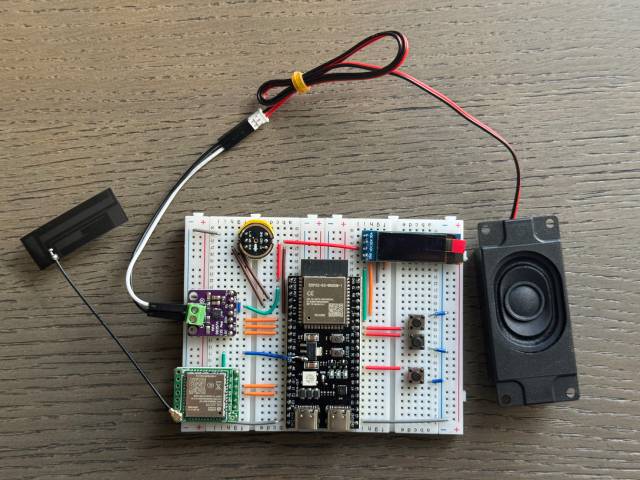
Breadboard DIY Practice
See the Feishu document tutorial:
👉 XiaoZhi AI Chatbot Encyclopedia
Breadboard demonstration:
Supported Open Source Hardware
- LiChuang ESP32-S3 Development Board
- Espressif ESP32-S3-BOX3
- M5Stack CoreS3
- AtomS3R + Echo Base
- AtomMatrix + Echo Base
- Magic Button 2.4
- Waveshare ESP32-S3-Touch-AMOLED-1.8
- LILYGO T-Circle-S3
- XiaGe Mini C3
- Moji XiaoZhi AI Derivative Version
- CuiCan AI pendant
- WMnologo-Xingzhi-1.54TFT
- SenseCAP Watcher


Firmware Section
Flashing Without Development Environment
For beginners, it's recommended to first use the firmware that can be flashed without setting up a development environment.
The firmware connects to the official xiaozhi.me server by default. Currently, personal users can register an account to use the Qwen real-time model for free.
👉 Flash Firmware Guide (No IDF Environment)
Development Environment
- Cursor or VSCode
- Install ESP-IDF plugin, select SDK version 5.3 or above
- Linux is preferred over Windows for faster compilation and fewer driver issues
- Use Google C++ code style, ensure compliance when submitting code
Developer Documentation
- Board Customization Guide - Learn how to create custom board adaptations for XiaoZhi
- IoT Control Module - Understand how to control IoT devices through AI voice commands
AI Agent Configuration
If you already have a XiaoZhi AI chatbot device, you can configure it through the xiaozhi.me console.
👉 Backend Operation Tutorial (Old Interface)
Technical Principles and Private Deployment
👉 Detailed WebSocket Communication Protocol Documentation
For server deployment on personal computers, refer to another MIT-licensed project xiaozhi-esp32-server