 Rdzleo
4b3206dca3
Rdzleo
4b3206dca3
v2.1 §11.10 真凶定位:
- 通过 Baji+Kapi 同 Wi-Fi 对比日志, 证明卡顿不是网络问题
- Baji WiFi 缓冲 8/10 vs Kapi 16/16, 加上 LVGL/GIF 抢 PSRAM 总线
- 同 BSSID 同信号下 Baji reor=1790, Kapi reor=0~226 (8 倍差距)
- 新增 Phase 7.8/7.9 修复方向

v2.2 §11.11 GIF 4 方案评估:
- 方案 A (GIF EMBED 转 C 数组) ❌ 否决: 占 +2MB 爆 OTA 分区, PSRAM 带宽不变
- 方案 B (通话期暂停 GIF) ⭐ 强推荐: 20 行 / 0 内存代价 / reor 1800→500
- 方案 C (RGB565 帧序列) ❌ 否决: Flash 不够
- 方案 D (PNG 序列 + lv_anim) ⚠️ 复杂可考虑
- 新增 Phase 7.10/7.11

v2.3 §11.12 硬件触顶诊断:
- 用户最终需求(说话期 GIF + 触摸放大渐变 + RTC)超 ESP32-S3 极限
- 全并发 PSRAM 带宽需求 40MB/s, 接近物理极限 60MB/s 的 67%
- 给出 3 条路径: A 分模式策略 / B 极限优化 / C 换 ESP32-P4
- 新增 Phase 7.12 + Phase 8

v2.4 §11.13 ESP32-P4 完整需求容量评估:
- 几十套 GIF Flash 占用: 30 套 21MB / 100 套 70MB → P4 需 32/64MB
- PSRAM 32MB 按需 LRU 缓存, 同时驻留 10 套 GIF 仅占 5MB
- PPA 硬件 2D 加速: 触摸缩放从 30% CPU + 30MB/s PSRAM 降到零 CPU
- 外挂 ESP32-C6: WiFi 6 / BLE 5.3 (比 S3 WiFi 4 抗丢包更强)
- BOM 升级 ¥20→¥53/台 (+¥30), 开发周期 3-6 个月
- 结论: 长期产品强烈建议直接立项 P4 v2, S3 v1 作快速上市验证
- Phase 8 细化为 8.1-8.6 子任务

文档累计 1335 行, 完整覆盖"S3 优化探索 → 触顶诊断 → P4 升级"决策链。

Co-Authored-By: Claude Opus 4.7 (1M context) <noreply@anthropic.com>
XiaoZhi AI Chatbot
Introduction
👉 Build your AI chat companion with ESP32+SenseVoice+Qwen72B!【bilibili】
👉 Equipping XiaoZhi with DeepSeek's smart brain【bilibili】
👉 Build your own AI companion, a beginner's guide【bilibili】
Project Purpose
This is an open-source project released under the MIT license, allowing anyone to use it freely, including for commercial purposes.
Through this project, we aim to help more people get started with AI hardware development and understand how to implement rapidly evolving large language models in actual hardware devices. Whether you're a student interested in AI or a developer exploring new technologies, this project offers valuable learning experiences.
Everyone is welcome to participate in the project's development and improvement. If you have any ideas or suggestions, please feel free to raise an Issue or join the chat group.
Learning & Discussion QQ Group: 376893254
Implemented Features
- Wi-Fi / ML307 Cat.1 4G
- BOOT button wake-up and interruption, supporting both click and long-press triggers
- Offline voice wake-up ESP-SR
- Streaming voice dialogue (WebSocket or UDP protocol)
- Support for 5 languages: Mandarin, Cantonese, English, Japanese, Korean SenseVoice
- Voice print recognition to identify who's calling AI's name 3D Speaker
- Large model TTS (Volcano Engine or CosyVoice)
- Large Language Models (Qwen, DeepSeek, Doubao)
- Configurable prompts and voice tones (custom characters)
- Short-term memory, self-summarizing after each conversation round
- OLED / LCD display showing signal strength or conversation content
- Support for LCD image expressions
- Multi-language support (Chinese, English)
Hardware Section
Breadboard DIY Practice
See the Feishu document tutorial:
👉 XiaoZhi AI Chatbot Encyclopedia
Breadboard demonstration:
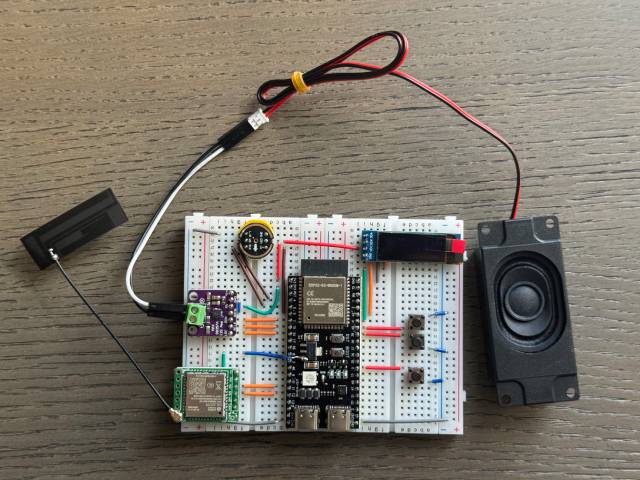
Supported Open Source Hardware
- LiChuang ESP32-S3 Development Board
- Espressif ESP32-S3-BOX3
- M5Stack CoreS3
- AtomS3R + Echo Base
- AtomMatrix + Echo Base
- Magic Button 2.4
- Waveshare ESP32-S3-Touch-AMOLED-1.8
- LILYGO T-Circle-S3
- XiaGe Mini C3
- Moji XiaoZhi AI Derivative Version
- CuiCan AI pendant
- WMnologo-Xingzhi-1.54TFT
- SenseCAP Watcher


Firmware Section
Flashing Without Development Environment
For beginners, it's recommended to first use the firmware that can be flashed without setting up a development environment.
The firmware connects to the official xiaozhi.me server by default. Currently, personal users can register an account to use the Qwen real-time model for free.
👉 Flash Firmware Guide (No IDF Environment)
Development Environment
- Cursor or VSCode
- Install ESP-IDF plugin, select SDK version 5.3 or above
- Linux is preferred over Windows for faster compilation and fewer driver issues
- Use Google C++ code style, ensure compliance when submitting code
Developer Documentation
- Board Customization Guide - Learn how to create custom board adaptations for XiaoZhi
- IoT Control Module - Understand how to control IoT devices through AI voice commands
AI Agent Configuration
If you already have a XiaoZhi AI chatbot device, you can configure it through the xiaozhi.me console.
👉 Backend Operation Tutorial (Old Interface)
Technical Principles and Private Deployment
👉 Detailed WebSocket Communication Protocol Documentation
For server deployment on personal computers, refer to another MIT-licensed project xiaozhi-esp32-server