 Rdzleo
497c1b4654
Rdzleo
497c1b4654
按 GSD 框架 .planning/milestones/digital_human_rtc/phases/phase_04_emotion_mapping/
规划完成 Phase 4 情绪映射 + 运行时切换。

## 核心变更

### bg_gif_demo 新增运行时切换接口

```c
esp_err_t bg_gif_demo_switch_gif(const char *new_gif_path);
```

实现要点:
- 先 heap_caps_free(g_gif_data) 释放旧 PSRAM,再加载新 GIF,单峰仅一份
- 内部 static last_gif_path 去重(相同路径直接返回 ESP_OK)
- 切换后立即 lv_timer_set_period(timer, 20) 防止 lv_gif_set_src 重建为默认 10ms
- LVGL 锁保护 200ms 超时

### 22 情绪 → 3 hiyori GIF 映射表

定义在 main/dzbj/ai_chat_ui.c USE_BG_GIF_POC 包裹内:

| GIF | 情绪标签 (个数) |
|-----|----------------|
| m06 (默认/积极) | neutral, happy, laughing, funny, loving, relaxed, delicious, kissy, confident, silly, blink, curious (12) |
| m07 (思考/疲倦) | sleepy, thinking, confused, embarrassed, dizzy (5) |
| m03 (负面/严肃) | sad, crying, angry, surprised, shocked (5) |

22 个标准情绪 100% 覆盖,未映射的情绪默认 fallback 到 m06。

### ai_chat_set_emotion 改造

PoC 模式下优先切换数字人大图(不再切隐藏的 emoji 200x89):

```c
#ifdef USE_BG_GIF_POC
if (bg_gif_demo_is_running()) {
    const char *path = find_hiyori_gif(emotion);
    bg_gif_demo_switch_gif(path);
    return;
}
#endif
// 非 PoC 模式 fallback emoji 路径保留
```

## 调用链(已与现有 RTC 字幕解析对接,无需改 application.cc)

RTC 字幕 → application.cc:1419 display->SetEmotion(emo)
  → AiChatDisplay::SetEmotion (display/ai_chat_display.cc)
  → ai_chat_set_emotion (dzbj/ai_chat_ui.c)
  → bg_gif_demo_switch_gif (PoC 模式)
  → 数字人 hiyori GIF 切换

## 烧录验证(用户实测)

监控 60s 期间捕获情绪切换:
- neutral / happy → m06(已在播,去重)
- thinking → m07 切换成功 (590ms 延迟)
- confused → m07 去重跳过
- AI 回复结束 → 自动回到 neutral
- 无 abort / 重启

m06 ↔ m07 切换屏幕可视确认,m03 走相同代码路径无需重复测试。

## GSD 文档(同时提交)

- .planning/milestones/digital_human_rtc/phases/phase_04_emotion_mapping/PLAN.md
- .planning/milestones/digital_human_rtc/phases/phase_04_emotion_mapping/EMOTION_REPORT.md
XiaoZhi AI Chatbot
Introduction
👉 Build your AI chat companion with ESP32+SenseVoice+Qwen72B!【bilibili】
👉 Equipping XiaoZhi with DeepSeek's smart brain【bilibili】
👉 Build your own AI companion, a beginner's guide【bilibili】
Project Purpose
This is an open-source project released under the MIT license, allowing anyone to use it freely, including for commercial purposes.
Through this project, we aim to help more people get started with AI hardware development and understand how to implement rapidly evolving large language models in actual hardware devices. Whether you're a student interested in AI or a developer exploring new technologies, this project offers valuable learning experiences.
Everyone is welcome to participate in the project's development and improvement. If you have any ideas or suggestions, please feel free to raise an Issue or join the chat group.
Learning & Discussion QQ Group: 376893254
Implemented Features
- Wi-Fi / ML307 Cat.1 4G
- BOOT button wake-up and interruption, supporting both click and long-press triggers
- Offline voice wake-up ESP-SR
- Streaming voice dialogue (WebSocket or UDP protocol)
- Support for 5 languages: Mandarin, Cantonese, English, Japanese, Korean SenseVoice
- Voice print recognition to identify who's calling AI's name 3D Speaker
- Large model TTS (Volcano Engine or CosyVoice)
- Large Language Models (Qwen, DeepSeek, Doubao)
- Configurable prompts and voice tones (custom characters)
- Short-term memory, self-summarizing after each conversation round
- OLED / LCD display showing signal strength or conversation content
- Support for LCD image expressions
- Multi-language support (Chinese, English)
Hardware Section
Breadboard DIY Practice
See the Feishu document tutorial:
👉 XiaoZhi AI Chatbot Encyclopedia
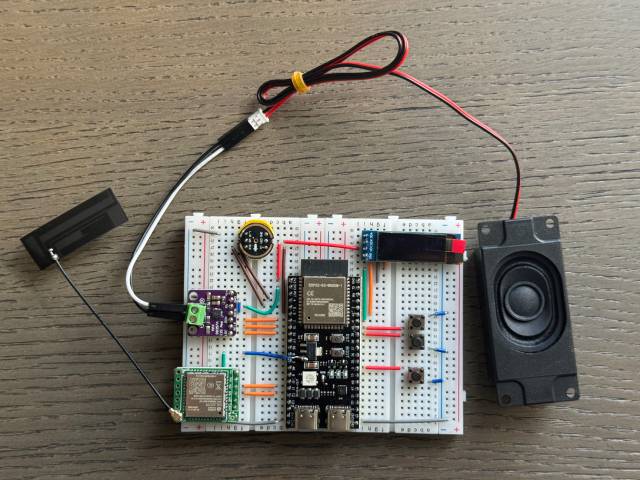
Breadboard demonstration:
Supported Open Source Hardware
- LiChuang ESP32-S3 Development Board
- Espressif ESP32-S3-BOX3
- M5Stack CoreS3
- AtomS3R + Echo Base
- AtomMatrix + Echo Base
- Magic Button 2.4
- Waveshare ESP32-S3-Touch-AMOLED-1.8
- LILYGO T-Circle-S3
- XiaGe Mini C3
- Moji XiaoZhi AI Derivative Version
- CuiCan AI pendant
- WMnologo-Xingzhi-1.54TFT
- SenseCAP Watcher


Firmware Section
Flashing Without Development Environment
For beginners, it's recommended to first use the firmware that can be flashed without setting up a development environment.
The firmware connects to the official xiaozhi.me server by default. Currently, personal users can register an account to use the Qwen real-time model for free.
👉 Flash Firmware Guide (No IDF Environment)
Development Environment
- Cursor or VSCode
- Install ESP-IDF plugin, select SDK version 5.3 or above
- Linux is preferred over Windows for faster compilation and fewer driver issues
- Use Google C++ code style, ensure compliance when submitting code
Developer Documentation
- Board Customization Guide - Learn how to create custom board adaptations for XiaoZhi
- IoT Control Module - Understand how to control IoT devices through AI voice commands
AI Agent Configuration
If you already have a XiaoZhi AI chatbot device, you can configure it through the xiaozhi.me console.
👉 Backend Operation Tutorial (Old Interface)
Technical Principles and Private Deployment
👉 Detailed WebSocket Communication Protocol Documentation
For server deployment on personal computers, refer to another MIT-licensed project xiaozhi-esp32-server