 Rdzleo
f1c2bfce93
Rdzleo
f1c2bfce93
核心变更:
- face_tracker.cc: YUYV→YVYU 序列修正(byte[1]=V, byte[3]=U),
  基于 JPEG Dump 诊断工具验证 OV3660 FORMAT_CTRL00=0x61 实际是 YVYU
- face_tracker.cc: 启动时 base64 打印一帧 JPEG 到串口,用于肉眼验证
- config.h: XCLK 20MHz→10MHz,给飞线信号完整性 2x 裕度
- scripts/auto_capture_jpeg.py: 自动串口抓帧工具(DTR/RTS 复位 + base64 解码)
- scripts/extract_jpeg_from_log.py: 从日志离线提取 JPEG
- Coglet项目分析与开发指南.md: 新增"六点六"章节,汇总 Phase 01
  主要矛盾(画面可辨识≠模型可识别)、YUV→RGB 色偏三层原因、
  esp-dl 模型输入分布敏感性、延迟分析、三方案对比、方案 B 突破口
- docs/: 新增 2 篇 OV3660 相关 CSDN 参考资料

Co-Authored-By: Claude Opus 4.7 (1M context) <noreply@anthropic.com>
An MCP-based Chatbot
Introduction
👉 Handcraft your AI girlfriend, beginner's guide【bilibili】
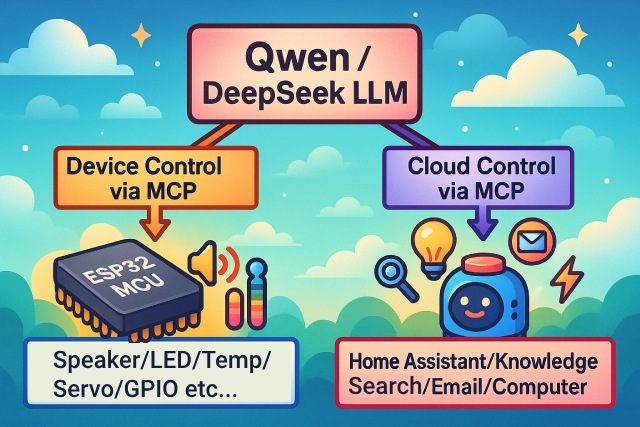
As a voice interaction entry, the XiaoZhi AI chatbot leverages the AI capabilities of large models like Qwen / DeepSeek, and achieves multi-terminal control via the MCP protocol.
Version Notes
The current v2 version is incompatible with the v1 partition table, so it is not possible to upgrade from v1 to v2 via OTA. For partition table details, see partitions/v2/README.md.
All hardware running v1 can be upgraded to v2 by manually flashing the firmware.
The stable version of v1 is 1.9.2. You can switch to v1 by running git checkout v1. The v1 branch will be maintained until February 2026.
Features Implemented
- Wi-Fi / ML307 Cat.1 4G
- Offline voice wake-up ESP-SR
- Supports two communication protocols (Websocket or MQTT+UDP)
- Uses OPUS audio codec
- Voice interaction based on streaming ASR + LLM + TTS architecture
- Speaker recognition, identifies the current speaker 3D Speaker
- OLED / LCD display, supports emoji display
- Battery display and power management
- Multi-language support (Chinese, English, Japanese)
- Supports ESP32-C3, ESP32-S3, ESP32-P4 chip platforms
- Device-side MCP for device control (Speaker, LED, Servo, GPIO, etc.)
- Cloud-side MCP to extend large model capabilities (smart home control, PC desktop operation, knowledge search, email, etc.)
- Customizable wake words, fonts, emojis, and chat backgrounds with online web-based editing (Custom Assets Generator)
Hardware
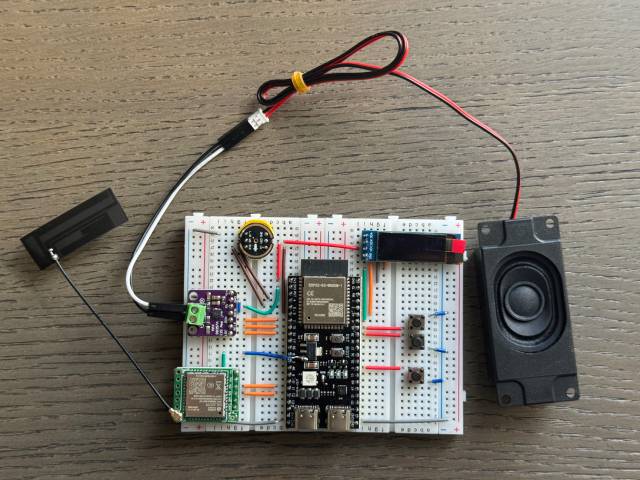
Breadboard DIY Practice
See the Feishu document tutorial:
👉 "XiaoZhi AI Chatbot Encyclopedia"
Breadboard demo:
Supports 70+ Open Source Hardware (Partial List)
- LiChuang ESP32-S3 Development Board
- Espressif ESP32-S3-BOX3
- M5Stack CoreS3
- M5Stack AtomS3R + Echo Base
- Magic Button 2.4
- Waveshare ESP32-S3-Touch-AMOLED-1.8
- LILYGO T-Circle-S3
- XiaGe Mini C3
- CuiCan AI Pendant
- WMnologo-Xingzhi-1.54TFT
- SenseCAP Watcher
- ESP-HI Low Cost Robot Dog


Software
Firmware Flashing
For beginners, it is recommended to use the firmware that can be flashed without setting up a development environment.
The firmware connects to the official xiaozhi.me server by default. Personal users can register an account to use the Qwen real-time model for free.
👉 Beginner's Firmware Flashing Guide
Development Environment
- Cursor or VSCode
- Install ESP-IDF plugin, select SDK version 5.4 or above
- Linux is better than Windows for faster compilation and fewer driver issues
- This project uses Google C++ code style, please ensure compliance when submitting code
Developer Documentation
- Custom Board Guide - Learn how to create custom boards for XiaoZhi AI
- MCP Protocol IoT Control Usage - Learn how to control IoT devices via MCP protocol
- MCP Protocol Interaction Flow - Device-side MCP protocol implementation
- MQTT + UDP Hybrid Communication Protocol Document
- A detailed WebSocket communication protocol document
Large Model Configuration
If you already have a XiaoZhi AI chatbot device and have connected to the official server, you can log in to the xiaozhi.me console for configuration.
👉 Backend Operation Video Tutorial (Old Interface)
Related Open Source Projects
For server deployment on personal computers, refer to the following open-source projects:
- xinnan-tech/xiaozhi-esp32-server Python server
- joey-zhou/xiaozhi-esp32-server-java Java server
- AnimeAIChat/xiaozhi-server-go Golang server
Other client projects using the XiaoZhi communication protocol:
- huangjunsen0406/py-xiaozhi Python client
- TOM88812/xiaozhi-android-client Android client
- 100askTeam/xiaozhi-linux Linux client by 100ask
- 78/xiaozhi-sf32 Bluetooth chip firmware by Sichuan
- QuecPython/solution-xiaozhiAI QuecPython firmware by Quectel
Custom Assets Tools:
- 78/xiaozhi-assets-generator Custom Assets Generator (Wake words, fonts, emojis, backgrounds)
About the Project
This is an open-source ESP32 project, released under the MIT license, allowing anyone to use it for free, including for commercial purposes.
We hope this project helps everyone understand AI hardware development and apply rapidly evolving large language models to real hardware devices.
If you have any ideas or suggestions, please feel free to raise Issues or join the QQ group: 1011329060